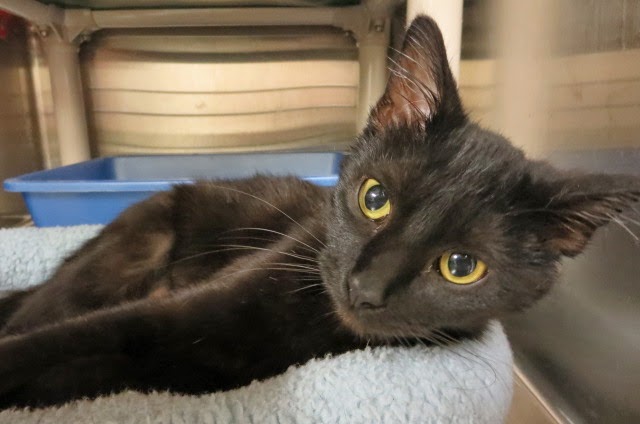
Monday, September 1, 2014

Kerrick and Denali

The next time you are at a Cats Cradle open house be sure to check out these two opposites.

Denali is a 1-2 year old high-energy cat.  He loves exploring and is quiet the athlete.  He is a dominant cat who likes to be in charge of other pets.  Denali is a muscular boy who jumps like a wild cat.  If you are looking for an adventurous guy he might be the one for you.


Kerrick is an 8-10 year old male.  Kerrick is loving and gentle and likes to be held.  He struggles with some of the other cats, but I'm sure would settle in nicely to his own home.  He prefers to be up high or in a wall box at the shelter to avoid the other cats in the room.  When things are calm he will come down for some head rubs and snuggles in someones arms.  If you need a sweet sole who will sit with you and be a loyal mate, please check on Kerrick.


Friday, August 22, 2014

Open House

Come see us at our open house on Saturday from 12:00-5:00.  While you are there be sure to check out some of the great cats from room four.
Abner

Artie

Greta

Teddy

Willis

Bert

Edith


Artie and Willis

Friday, August 8, 2014

Guide to Behavior Problems in Cats

Even though they have a reputation for being independent and self-sufficient, some cats develop behavior problems or bad habits that demand attention. Before finding a new home for your cat, or banishing it to the perilous outdoors, consider learning what is causing the problem, how to deal with the behavior, and how to re-train your pet. With proper know-how, your cat can once again be a loving and enjoyable member of the family.

Inappropriate elimination. Inappropriate elimination is not one condition but rather a cluster of conditions: some medical, some physiological (pertaining to normal biological functions), some to do with elimination preferences, and others related to anxiety and stress. Some cats just stop using the litter box. Others use the litter box for elimination purposes but also mark their territory with urine or feces.

Feline aggression. Aggression is a natural behavior for the cat and was a survival-necessary behavior for the cats' wild ancestors. Although cats have long been thought of as solitary creatures, it has recently been recognized that they can live in true societies and that some may develop as leaders or "alpha" cats. Cats of this persuasion will use affective offensive aggression to procure privileges for themselves.

Aggression directed at other cats. Cats show several different types of aggression toward other cats including status-related (dominance) aggression, fear aggression, territorial aggression, and redirected aggression.

Play aggression. Kittens are adorable, but when they are around four months of age, a shady side of their personality often emerges – a side that involves aggression. In an instant, a kitten can turn aggressive, inflicting painful scratches and bites on its owner. Play aggression is a normal feature of development. In time, it diminishes and eventually disappears but sometimes owners need it to stop or be redirected NOW.

Predatory aggression. Predation is the way in which cats in nature obtain their food. It is debatable whether this behavior classifies as aggression in the true sense of the word but, because it involves the destruction of a third party, it is usually classified along with other types of aggression. Typically, cats hide behind walls, stalking and pouncing on approaching feet and ankles, inflicting scratches and minor bite wounds. Mature cats will capture and kill small rodents and birds.

Medical problems. There are a variety of medical causes of aggression in cats. These include hyperthyroidism, ischemic encephalopathy, brain tumor, head trauma, and thiamine deficiency.
         
Feline fear. As unpleasant as fear may be to experience, it keeps us and our animals safe by encouraging caution and by preparing us for fight or flight when danger threatens. Problems arise, however, if fears become so excessive and irrational that they disrupt normal functioning.

Separation anxiety. Separation anxiety in any species implies a lack of confidence and an over-dependence on others. Cats with separation anxiety don't howl and bay like dogs and they don't chew on doors and windowsills in frantic attempts to escape. Their misery is far less obvious and it sometimes takes a sleuth of an owner to appreciate what is going on. Housesoiling occurring only in the owner's absence is a good clue.

Thunderstorm phobia.  Few species – including humans – are happy with the sounds of a rip-roaring thunderstorm, complete with darkened skies, lightning, and crashing thunder. But some animals become extremely fearful to the point where they show a full-blown phobia. Cats are probably far from comfortable in storms but most don't become phobic – although there are a few notable exceptions.

Compulsive behaviors. Compulsive behavior initially may be performed as a displacement behavior. For example, when a cat is torn between responding with aggression or running away, he may displace into a seemingly unrelated behavior, such as grooming, as a way to reduce emotional tension. The most common compulsive behaviors exhibited by cats include wool sucking or fabric eating, over-grooming/hair-barbering/hair-pulling behavior, and feline hyperesthesia.

Feeding compulsion. Many cats suffer from eating compulsions. Like people, cats may use their compulsive disorders as an outlet when natural behaviors are inhibited by poor management practices and/or a restrictive environment. Genetic factors may also be involved.

Hoarding behavior. In the domestic situation, depositing dead prey animals on the front doorstep is probably one of the most well known forms of feline gathering behavior. Collecting and hoarding of shiny objects, including jewelry and small metal objects, may also occur; the items are not just retrieved; they are stashed and hoarded.

Hyperesthesia. Cats affected by this syndrome show the most bizarre character changes, sometimes appearing to hallucinate, act manically, schizophrenic, or even "possessed." This behavior occurs in bouts.

Psychogenic alopecia. The result of compulsive hair pulling is alopecia (baldness) that can be so mild as to be barely discernable or so severe as to completely denude the skin. The areas most commonly involved are the abdomen and the inside of the limbs.

Furniture scratching. Cats love to scratch. Unfortunately, the things they love to scratch are often the legs of your antique table, your upholstered sofa, or your expensive stereo speakers. And no amount of reprimanding or pulling out your hair in frustration will make them stop. But there are ways of redirecting this species-typical behavior of cats.

Jumping on counters. There are two main reasons why cats find countertops so appealing: 1. Because cats naturally prefer a three-dimensional environment 2. Because they occasionally find food morsels while patrolling the surfaces. You can either work hard at retraining your cat(s) or teach yourself not to worry so much about your cat's counter-surfing.

Once you understand what is underlies your cat's behavior and realize what is needed to correct the problem, you are well on your way to keeping your family intact.

Source: http://www.petplace.com

Cat Facts

  1. On average, cats spend 2/3 of every day sleeping. That means a nine-year-old cat has been awake for only three years of its life.
  2. Unlike dogs, cats do not have a sweet tooth. Scientists believe this is due to a mutation in a key taste receptor.
  3. When a cat chases its prey, it keeps its head level. Dogs and humans bob their heads up and down.
  4. The technical term for a cat’s hairball is a “bezoar.
  5. A group of cats is called a “clowder.”
  6. Female cats tend to be right pawed, while male cats are more often left pawed. Interestingly, while 90% of humans are right handed, the remaining 10% of lefties also tend to be male.
  7. A cat can’t climb head first down a tree because every claw on a cat’s paw points the same way. To get down from a tree, a cat must back down.
  8. Cats make about 100 different sounds. Dogs make only about 10.


Taken from: http://facts.randomhistory.com/interesting-facts-about-cats.html
Argo

Nadine

Ponsford


Stars and Stripes

Willis

Deniro and Desi
Cher

Mindi and Jonny

Tuesday, August 5, 2014

Kitten & Cat Proofing Your Home

Here are some ways to kitten (and cat) proof your home to keep them safe!

1. String
Keep string, ribbon, yarn, tinsel, rubber bands, plastic jug rings, paper clips, pins, dental floss, and other temptations away from your curious cat.  Anything string-like that is swallowed by your cat can cause a partial or complete obstruction.  It can saw through the wall of the intestinal tract and cause peritonitis, an inflammation of the membrane that lines the abdominal cavity and abdominal organs.

Keep sewing baskets behind closed doors.  Put dental floss and string in a trash container with a secure lid.  Don’t use yarn or ribbons to decorate packages.  Hide rubber bands and toys with tails or streamers.  Keep shoes in closets to protect kittens from ingesting the shoelaces.  Put away decorative throw pillows, blankets bordered with tassels or fringe until the kitten is older and less curious.

Toys that dangle from a string are great fun and an excellent way to interact with your pet.  However, these should never be left alone with the kitten because they pose a risk if the string is swallowed or if it gets wrapped around the kitten’s neck during play.  Put fishing-pole toys in a closet with a closed door when you can’t be around to supervise playtime.

2. Cords and Curtains
Fold and secure your window blinds cord out of kitty's reach. If she gets tangled up in it, she could strangle.  It never hurts to flip your curtains up over their rods for a couple months.  Tuck electrical cords out of the kitty’s reach.  Cover electric cords, such as the tangle from your computer, with covers sold for that purpose.  Look for cord organizers that enclose them in chew-proof tubes.

3. Medication
Never give a kitten any medication without checking with your veterinarian first.  Be extra carful to pick up any pills you drop.

4. Plants
Kittens love to nibble on greenery.  Keep harmful plants like chrysanthemum, azalea, tulip bulbs, oleander, sago palms, rhododendrons and castor beans are just a few of the plants that can be harmful to your cat.  Lilies are particularly poisonous, and even small amounts can make your kitten sick.

Put away or throw away anything that might tempt a kitten to eat it, including potpourri scented with aromatic oils.  It may smell wonderful, but it can be deadly if your cat eats them.

5. Appliances, Furniture & Crawlspaces
Kittens will explore, play or nap in small, dark places like the washer or dryer, the sleeper sofa or under the recliner.  Always keep the door to your clothes dryer closed, and double-check inside before using it. Be aware of where your cat or kitten is before closing the refrigerator door.  The food can be enticing, but they can quickly suffer from hypothermia.

Do a kitten search before folding up the sleeper sofa or lowering the footrest of a recliner.  Pets can become trapped underneath and be severely injured.  Keep your toilet lid down at all times, lest kitty fall in or drink from it. Better yet, keep your bathroom off-limits to your kitten unless you absolutely have to keep her litter box there.

Consider purchasing inexpensive baby latches for floor-level cupboards and closets.  An especially curious cat may need baby latches on upper level cupboards as well.  Be on the lookout for potential access points that your kitten could sneak into.  Watch out for spaces under curios and hutches.  Kittens can become trapped there.

Adding Kittens to Your Home

Kitten season is upon us.  Be sure you have everything ready before brining your new kitten home. 

1.       Litter box – The sides should be short enough that the kitten can easily climb in and out.  Place the box in a quiet spot and show her where it is.  If possible, keep a litter box on each level of your home.  You may need to have a litter box in multiple rooms on a single level for your kitten.  Kittens are small and may not be able to get to the litter box in time if it is too far away.  While they are new to your home, they may not remember where the litter box is located.

2.       Cat carrier – Your pet needs a safe place to be when being transported to the vet or other destination.  Hard-sided carriers are best as they provide better protection than a soft-sided carrier if you are in an accident.

3.       Cat bed – Cats sleep up to 16 hours a day, kittens even more.  If you have a dog, it’s important to give your kitten a safe and private place to sleep.

4.       Kitten food – Until they are 1 year old, kittens need up to three times the calories as adult cats.  Look for food made especially for kittens and feed the recommended amount on the label.  If you have a dog, place the food where the dog cannot get to, as kitty food can upset a dog’s stomach and add unwanted pounds.

5.       Water bowls – Place several water bowls throughout the house.  Keep them clean and filled with cool, fresh water.  If your kitten is not drinking much, try a flatter dish that does not surround her small face.  Some cats do not like their whiskers touching the sides of the bowl.  If your cat prefers running water, a kitty water fountain may work better than a regular dish.

6.       Cat proof – Put away cleaners and pick up anything they could swallow.  More information on properly kitten-proofing your home will be posted later this week.

7.       Perches & toys – Kitties enjoy looking out windows and watching the birds.  Cat stands and window beds allow your pet to be safely entertained by birds, rabbits and other wildlife.  They also provide a safe place to get away from other pets in the house.  Cats and kittens love to play.  Ensure that you have safe toys for your pet to play with.  Even commercial cat toys should be checked for loose strings, holes and small pieces that can come off (e.g. eyes and noses).  Some cats will eat these small items which can be dangerous.  

8.       Scratching surfaces – Kittens (and cats) need to learn where it is OK to scratch.  To keep kitty off the curtains, give her a sisal-covered pole to climb up.  Don’t wand kitty clawing the couch?  Put up scratching posts.  Show your kitty how to use the approved scratching surfaces.  Pretend to sharpen your claws on them, or sprinkle some catnip on the surfaces.  Make sure that any posts are well secured.  Bitter Apple or lemon-scented sprays are both great for marking areas you want to be off-limits. Cats hate the taste and/or scent of them.

9.   Play  Be prepared to gently play with your kitten each day.  This keeps her fit, develops coordination and provides an outlet for chasing and pouncing.  If she likes to use her teeth or claws, give her something to bite on or cling to when playing.  Do not use your hand as a toy!  If she thinks that hands are toys, she might accidently hurt someone.

Source: pets.webmd.com, petstreet.com, cats.about.com

Saturday, August 2, 2014

Valley Cats Video Contest

Hello Red River Valley.  Have you adopted a cat from CCS?  Even if you have not, we invite area cat lovers to submit their on cat videos as part of the Internet Cat Video Festival screening at the Fargo Theatre on September 4.

Entries will be juried and the winners will appear in a special segment called Valley Cats.  Entry forms are due by Friday, August 8.  Submit the form to Becky Dunham at bdunham@plainsart.org along with a .mov file via Dropbox.  Each video must be two minutes or less.  Click on the link below for the entry form.

Valley Cats Entry Form

Friday, August 1, 2014

Open House - KITTENS!!!

Kittens, kittens and MORE kittens!  We have over 60 kittens in foster care, some of which will be at our open house on Saturday from 12:00 - 5:00 pm.  If you are looking to add a kitten (or two, or three…) to your family, stop by and see us.  We are located at 9  9th Street South, Fargo.

Here are a few pictures of our cute and curious kittens.

Chevy


Deniro

Desi

Finch

Harry Potter

Jewel

Ron Weasley


Stars-n-Stripes

Monday, July 28, 2014

Fund Raiser - Chili's Give Back Program

Right click on the voucher below to open in a new tab.  Print the voucher and share with your friends.  

Take the voucher when you visit Chili's in Fargo (at the address indicated) and 15% of your purchase (excluding taxes) will benefit Cats Cradle Shelter.  This offer is in effect 8/1/14 to 11/1/14.  

Thank you Chili's for supporting CCS!


Sunday, July 27, 2014

Cat Nap

How about a Sunday afternoon catnap.  Cats sleep 15 or more hours each day.  Here are some of the sweet cats at Cats Cradle Shelter having their daily rest.


Friday, July 18, 2014

Open House - Available Cats

Looking for something to do this weekend?  Thinking of adding a four-legged friend to your home?

Stop in on Saturday for our open house from 12:00 pm - 5:00 pm.  We are located at 9  9th street south in Fargo.  Can't make it on Saturday?  We are also open Tuesdays from 4:00 – 7:00 pm, and by appointment.  You can reach us at 701-356-7877.   If we are unavailable, please leave a message and we will get back to you.

We typically have 40 - 50 cats in-house that are waiting for their forever home.  Here are pictures of just a few of the cats that CCS has rescued.  Stop by and meet them in person!

April

Charisma

Columbus

Cuddles

Edith

Ginger

Rocco

15 Signs That your Cat is a Furry Child

Is your cat part of your family? Do you refer to yourself as your cat's mom or dad? Cats that are loved and valued as a child are lucky cats.

It is becoming more common for cats to be a valued member of a household, rather than a replaceable possession. While there is still far too much of it, it is less acceptable for a cat to live wandering the streets, fending for itself. This trend is being replaced by cats regarded as children, living in a loving home with their own warm bed, nutritious meals, and much spoiling!

Signs that your cat is a furry child:

1. You always carry a picture of your cat in your wallet, and you show it off often.
2. Your cat has his or her own stocking and gifts under the Christmas tree.
3. You always keep cat treats on your counter.
4. The plant life in your home includes cat nip and cat grass.
5. Your cat has birthday parties.
6. A common form of decor in your home is the cat tree.

7. Instead of the kennel, your cat has a relative, friend or cat sitter come to your home.
8. Your cat drinks from your milk glass, and instead of getting new milk, you just drink after him or her.
9. Your cat has health insurance.
10. There are arrangements in your will for you cat.
11. You have been known to take your cat for a walk in a stroller.
12. Your friends threw you a shower when you got your kitten.
13. You've called off work because your cat is ill.
14. Spending quality time with your cat everyday is a priority.
15. Head rubs and purrs from your cat are welcomed.

Treating your cat with the respect you would give a child is not only fun, it is important. Cats are living beings just as much as kids are. They feel, think (some more than others!), love, and need like kids. Having a child should be taken very seriously, and so should getting a cat. Both are responsibilities. Both need medical care, shelter, proper diet, and your time and affection. Both are lifelong commitments.

Of course, there are many aspects of cat-raising that are easier than raising a child. Cats don't go to college. They don't absolutely need a babysitter while you're at work. They litter box train quickly. Cats don't get speeding tickets. They don't throw temper tantrums at the movie theater. And at the end of a long day, what is more soothing - a purring loving cat or a puzzling, algebra equation?

Source: http://www.petplace.com

Sunday, July 13, 2014

Jade

Jade (middle) is the sweetest, petite little girl.  She loves curling up in a lap and being wrapped in a blanket.  She is still a little nervous, but Ponsford (left) and Nevis (right) are doing their best to make her feel secure.  If you have room for any of these lovable cats visit the shelter on Tuesdays (4:00-7:00) or Saturdays (12:00-5:00).